Classical music
Gustave Doret

Gustave Doret (Aigle, 20 September 1866 – Lausanne, 19 April 1943) is one of the great names of French-speaking Swiss music. A conductor and composer trained in Berlin and Paris, he was, at the turn of the century, a figure of Parisian musical life before putting his craft at the service of his homeland. He tied his name to Vevey by writing the music for two Fêtes des Vignerons, those of 1905 and 1927, and founded with the writer René Morax the Théâtre du Jorat, in Mézières. The town of Vevey dedicated an avenue to him, between the Chemin de la Palud and the Route de Saint-Légier.
Gustave Doret: from Aigle to the Paris stages, and back home
A son of Aigle trained in Berlin and Paris
Gustave Doret was born in Aigle in 1866, into a Protestant family from the Dauphiné that had taken refuge in Switzerland after the revocation of the Edict of Nantes. His grandfather, a banker in Turin, had come back to make his fortune at home; his father Paul managed the family’s property and vineyards, and his mother, Marie Girard, came from Yvorne, the neighbouring village.
Enrolled in medicine at the University of Lausanne in 1884, he soon turned to music: in 1887 he went to Berlin to study the violin with Joseph Joachim, then on to Paris, where he studied composition with Théodore Dubois and Jules Massenet, and the violin with Martin Pierre Marsick.
Second conductor at the Concerts d’Harcourt from 1893 to 1895, he then succeeded Gabriel-Marie at the head of the Société Nationale de Musique. It was in that role that, on 22 December 1894, he gave the premiere of the “Prélude à l’après-midi d’un faune” by his friend Claude Debussy, one of the pieces that opened the door to modern music.
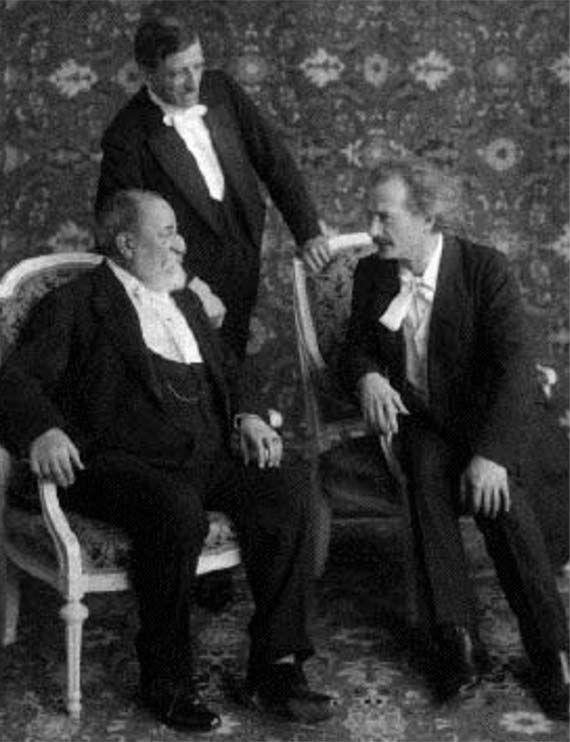
The Opéra-Comique and the Théâtre du Jorat
In 1904 he conducted the orchestra of the Paris Opéra-Comique for the premiere of his own opera, “Les Armaillis”, and became its musical director in 1907. His career was by then divided between France and Switzerland: Paris music correspondent of the “Berliner Tageblatt” from 1910 to 1914, he also conducted the London Symphony Orchestra in 1912, with Ignacy Jan Paderewski at the piano, and appeared several times in Rome.
It was with the Vaud writer René Morax that he formed his most lasting partnership. Together they opened the Théâtre du Jorat, in Mézières, in 1908, with “Henriette”, a show that met with great success in Switzerland, France and Belgium. Doret would return there several times. In 1926 his opera “La Tisseuse d’orties” was premiered at the Opéra-Comique; the same year he was made an Officer of the Legion of Honour, and in 1936 he entered the Institut de France as a corresponding member of the Académie des Beaux-Arts.
1905 and 1927: two Winegrowers’ Festivals
A rare event, inscribed since 2016 on UNESCO’s intangible heritage list, the Fête des Vignerons in Vevey is held only once a generation. Gustave Doret composed its music twice, in 1905 and again in 1927. For the 1905 edition, some eighteen hundred singers and musicians performed his score.
From 1914 to 1929 he taught at the Geneva Conservatory, then, from 1921, at the Paris Conservatory. He also wrote in the newspapers of Lausanne and Geneva, a tireless champion of the French-Swiss repertoire. At his death, in 1943, Vevey had not forgotten the composer of its great festivals: an avenue in the town bears his name.
These places on the map
Tap a marker to open the place page.