Classical music
Camille Saint-Saëns

Camille Saint-Saëns (1835-1921), composer, pianist and organist, long reigned over Parisian musical life and was admired by the greatest, from Franz Liszt to Richard Wagner. A great traveller, he made Switzerland one of his favourite destinations: the musicologist Stéphane Leteuré has counted more than fifteen visits there. The most memorable remains that of May 1913, when the town of Vevey gave him four days of “Fêtes musicales” under the direction of his friend Gustave Doret, with the participation of the pianist Ignacy Jan Paderewski. In Vevey, a space in the Salle del Castillo, the former Casino du Rivage that hosted him, now bears his name.
Camille Saint-Saëns and the Fêtes musicales de Vevey (1913)
A globe-trotter on familiar ground
When he reached Vevey in May 1913, Saint-Saëns was seventy-seven and no stranger to Switzerland. The musicologist Stéphane Leteuré, in “Camille Saint-Saëns, le compositeur globe-trotter”, has traced more than fifteen journeys, in both French- and German-speaking Switzerland. As early as 1877, aged forty-two, he had given his first concert in Geneva under Hugo de Senger, a kind of nineteenth-century Ernest Ansermet.
He was by then a leading figure of European music, a composer and keyboard player of such virtuosity and gift for improvisation that Liszt had called him “the greatest organist in the world”. He returned several times: in 1896 for the National Exhibition, then in 1910 and 1911 for concerts. In 1913 the aim was to celebrate a whole career, but also to champion French music against the Wagnerian wave that had swept Europe.
Four days of festivities, 18 to 21 May 1913
The Fêtes musicales ran from 18 to 21 May 1913, under the direction of Gustave Doret, with the Munich Konzertverein, the choral society and the Ladies’ Choir of Vevey. Concerts were given at the Casino du Rivage (today the Salle del Castillo) and at the Temple Saint-Martin, while the Hôtel des Trois Couronnes hosted rehearsals and receptions. The young Ernest Ansermet, at the start of his career, took charge of the choirs.
The pianist Ignacy Jan Paderewski had also been invited, and with him Saint-Saëns was to play his “Polonaise for two pianos op. 77”. “Having those two musicians on the same stage was then the equivalent of Johnny Hallyday at the Olympia, a media buzz” sums up the organist Jacques Tchamkerten. In a salon of the Trois Couronnes, on the eve of the concert, a nervous Saint-Saëns is said to have told Paderewski: “Let us work, we have to be up to it!” According to Stéphane Leteuré, the old master dreaded this duet, judging Paderewski a far better pianist than himself.
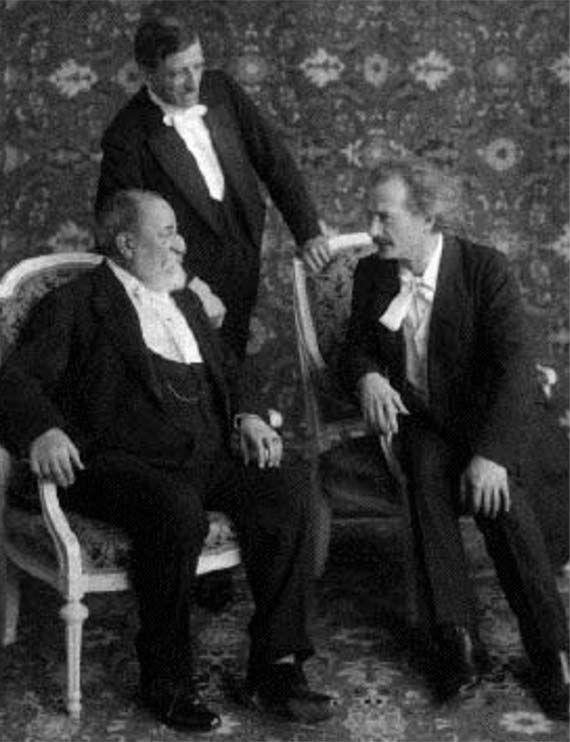
He conducted several of his works, including the symphonic poem “Phaéton” and the “Hymne à Victor Hugo op. 69”, and played the organ in his “Coronation March for Edward VII” and his “Symphony in C minor” with organ, accompanied by the Munich orchestra. For his friend Doret, the point was to “show the Swiss cultural world that one need not swear by German composers alone”.
The success was considerable: the hall had to be opened to the public even for the rehearsals. When the final chord sounded, the composer, astonished and delighted, was presented with a crown in the colours of Vevey; plaques and medals bearing the likeness of the two artists were struck. The newspaper of the day put this triumph down to “the respectful admiration of which the eminent French composer is the object”. Asked by the organisers to write the festival’s programme notice, the writer Romain Rolland hailed “a representative of the French classical spirit” endowed with “the first of all” its qualities, “perfect clarity”.
A century’s last farewell
The reviews were mostly rapturous, “one of the greatest displays of art ever held in our country”, enthused one chronicler. Yet one voice broke away, that of the musicologist Aloys Mooser, who lamented works “below average in value” and predicted a fragile posterity, except for the “Third Symphony”. “He was right” concedes Jacques Tchamkerten: “inspired though he was, this composer sometimes called academic did not forge a new language, as Debussy, Ravel and Igor Stravinsky were doing at that very moment, his ‘Rite of Spring’ premiered in Paris that same month.”
After Vevey, Saint-Saëns went on to Geneva, then to Lausanne in October 1913 for a further festival in his honour, marking his seventy-eighth birthday. His visit was above all a tribute, with no lasting influence on local artistic life: like the last farewell of a nineteenth century that the daring of the “Rite” had just buried. It would take a century for his concertos and symphonies to be rediscovered, and for “The Swan” or the “Danse macabre” to become hits.
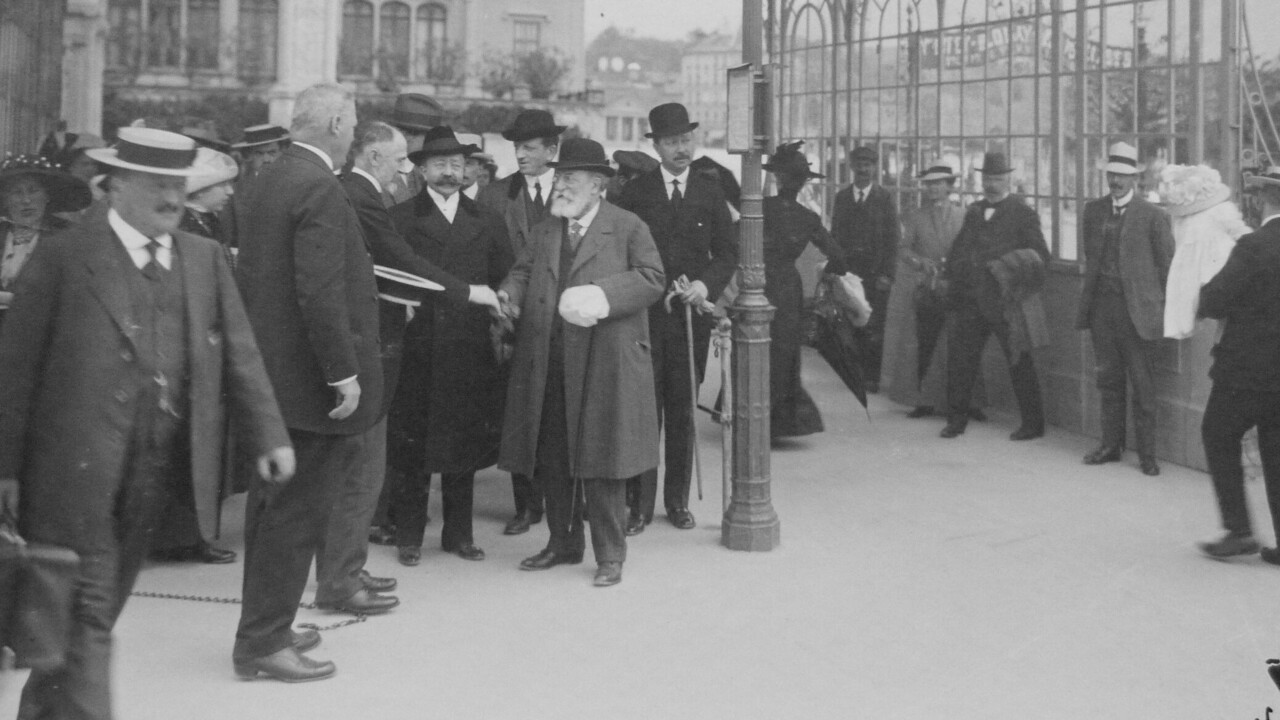
In Vevey, the memory of that spring of 1913 has stayed alive: a space in the Salle del Castillo, the former Casino du Rivage, bears the name of Camille Saint-Saëns, next to the Salon Clara Haskil. In March 2025, the Hôtel des Trois Couronnes paid tribute to his visit, a hundred and twelve years later (24 heures; RTS).
These places on the map
Tap a marker to open the place page.