Classical music
Ernest Ansermet

Ernest Ansermet (1883-1969), one of the great conductors of the twentieth century, was a son of Vevey. A mathematics teacher turned musician, he cut his teeth leading the concerts of the Kursaal de Montreux, whose direction he took over in 1912, succeeding the Portuguese Francisco de Lacerda. It was on the Riviera that he formed a decisive friendship with Igor Stravinsky, then living in Clarens: Ansermet would later premiere many of his works. In 1918 he founded the Orchestre de la Suisse Romande, which he would conduct for nearly half a century, championing Debussy, Ravel and all of modern music. A demanding theorist, he left a landmark book, “The Foundations of Music in Human Consciousness”. Montreux and Vevey each dedicated a Quai Ernest-Ansermet to him along the lake; in Montreux, close to the Rue Igor-Stravinsky that honours his friend.
Ernest Ansermet, from the Kursaal de Montreux to the Orchestre de la Suisse Romande
A son of Vevey who came from mathematics
Ernest Ansermet was born in Vevey in 1883, into a family of amateur musicians. Drawn to music from an early age, he nonetheless chose mathematics: a science degree from the University of Lausanne in 1903, then a doctorate begun at the Sorbonne, where he also attended classes at the Paris Conservatoire.
In 1909 he spent a year in Berlin, sitting in on rehearsals of the Philharmonic under Nikisch, Richard Strauss, Felix Mottl and Karl Muck. Back in Switzerland, he made up his mind: it would be conducting.
The Riviera springboard
From 1910 Ansermet conducted concerts in Lausanne, then won by competition the direction of the Kursaal de Montreux concerts, which he took over in 1912 from the Portuguese Francisco de Lacerda. He was already programming Debussy, whom he had met in Paris. The Riviera was the springboard of his career.
In his Kursaal orchestra sat a sixteen-year-old leader: Carlo Boller, the future founder of La Chanson de Montreux. In 1915 Diaghilev called Ansermet to head the orchestra of the Ballets Russes.
Friend of Stravinsky and the Ballets Russes
It was on the Riviera, through the writer C. F. Ramuz, that Ansermet grew close to Igor Stravinsky, then living in Clarens. He witnessed the genesis of The Rite of Spring, Petrushka and The Soldier’s Tale, whose premiere he conducted in Lausanne on 28 September 1918.
With the Ballets Russes and then the Orchestre de la Suisse Romande, he went on to premiere a great many twentieth-century works: Stravinsky’s Pulcinella, Renard, Les Noces and The Song of the Nightingale, Falla’s The Three-Cornered Hat, Prokofiev’s Chout, Satie’s Parade.
1918: the Orchestre de la Suisse Romande
In 1918 Ansermet founded the Orchestre Romand in Geneva to give French-speaking Switzerland a symphonic tradition. In 1932 he tied the orchestra to Radio-Genève, which broadcast all its concerts; in 1938 the station opened a studio with a large concert hall, today’s Studio Ernest-Ansermet, where he would conduct more than 450 concerts.
Now the Orchestre de la Suisse Romande, the ensemble settled permanently in Geneva. Ansermet led it until 1967, then handed over to Paul Kletzki without giving up conducting: his last evening at the head of the OSR was on 30 December 1968. He died on 20 February 1969.
His discography, recorded mostly for Decca, made the orchestra and French-speaking Switzerland known around the world, carried by the many premieres he gave: Stravinsky, Debussy, Ravel, Honegger, Frank Martin, Britten, Bloch.
A conductor who was also a thinker
A demanding mind, Ansermet was a theorist as well as a conductor. He published The Conductor’s Gesture (1943), then, in 1961, The Foundations of Music in Human Consciousness, a vast reflection in which he defended tonality and voiced his reservations about atonal music. The work remains a debated reference.
Montreux and Vevey remember
Two Quais Ernest-Ansermet now run along the lake: one in Montreux, close to the Rue Igor-Stravinsky that honours his friend, the other in Vevey, his home town. In Geneva, the radio studio where he gave more than 450 concerts also bears his name.
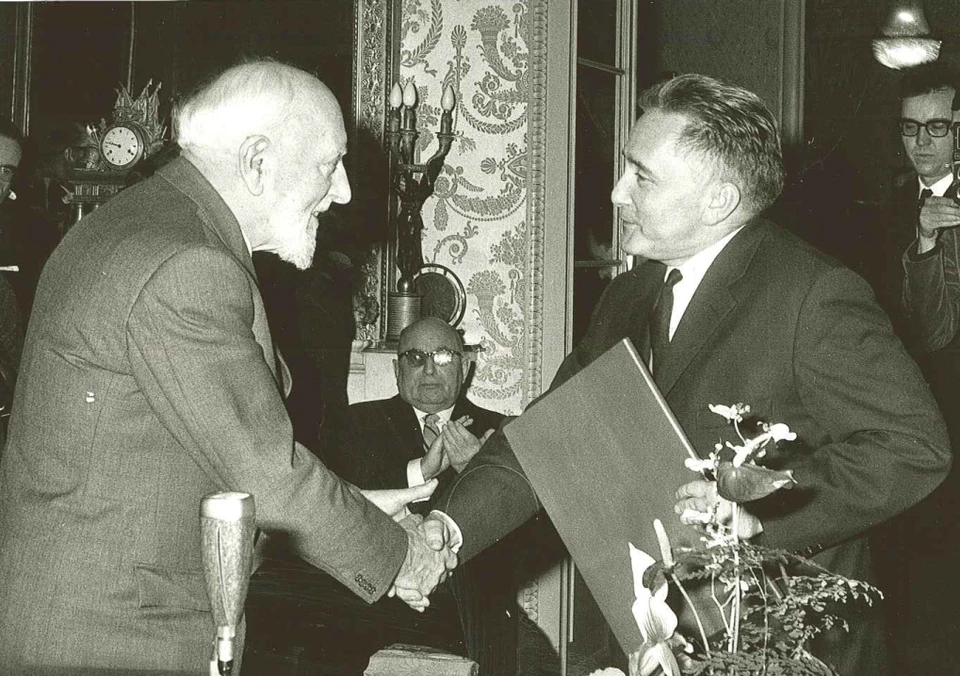
In 1955 France made him a Commander of the Legion of Honour; the ceremony took place in that studio, with all the musicians of the Orchestre de la Suisse Romande gathered around him.
Geneva, Vevey and Lausanne each made him an honorary citizen; it was in Lausanne that he had taught mathematics at the college before becoming a conductor.
These places on the map
Tap a marker to open the place page.