Classical music
Richard Strauss

Richard Strauss (1864-1949) spent the last years of his life in Switzerland, and Montreux holds a precise place in that final stretch. The final sketch of “Im Abendrot”, the song that closes the “Four Last Songs”, is inscribed “Montreux, 27 April 1948”. He was eighty-three and would die the following year. Those four songs, published after his death, are regarded as his farewell and as a last love letter to his wife, the soprano Pauline de Ahna, whom he had married nearly sixty years earlier.
Richard Strauss: “Montreux, 27 April 1948”
A date written on a score
Montreux’s trace in Richard Strauss’s work is not a hotel anecdote: it is written on the manuscript. The final sketch of “Im Abendrot”, on a poem by Joseph von Eichendorff, is dated “Montreux, 27 April 1948”. The full score was completed on 6 May.
The composer was then eighty-three. He had been living in Switzerland since the end of the war. His son Franz had urged him to stop writing letters and return to composing, suggesting he take up the lied again.
The Four Last Songs
“Im Abendrot” came first, yet it closes the set in concert. The three other songs, on poems by Hermann Hesse, followed during 1948: “Frühling”, completed at Pontresina on 18 July, “Beim Schlafengehen” on 4 August, “September” on 20 September.
Strauss died on 8 September 1949 without having heard them. The set was published posthumously as “Vier letzte Lieder”. Eichendorff’s text, describing two old companions watching the sunset and asking “is this perhaps death?”, gives these pages their testamentary weight.
The Montreux Palace, his final months
Strauss composed these songs largely from the Montreux Palace, where he was staying. In 1947 he met there the writer Hermann Hesse, a Nobel laureate in literature then living in Switzerland; it was on three of Hesse’s poems that he would write “Frühling”, “Beim Schlafengehen” and “September”.
It was also at the Palace that he put the finishing touch to his music: his very last score, a song titled “Malven”, was written there. In 1949, weakened, he stayed at the Clinique Florimont before returning to the hotel, then went home to Germany: he died at Garmisch in September of that year.
His bust on the Quai de Vernex
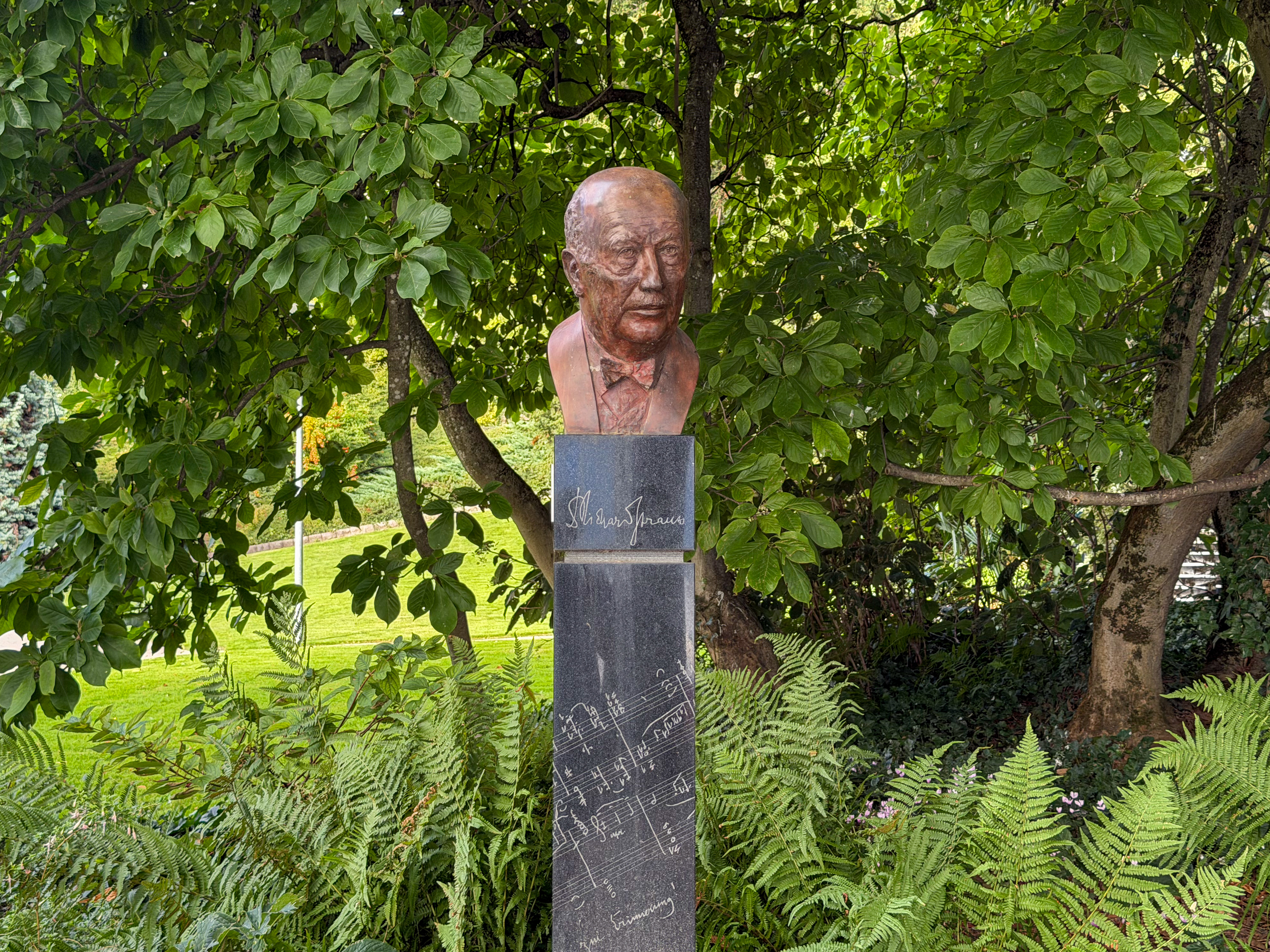
His bust, by the Montreux sculptor Bernard Bavaud, was unveiled on 11 May 2013 on the Quai de Vernex, in front of the Auditorium Stravinski, in the presence of the German ambassador and the Montreux authorities. It was given by the Friends of Richard Strauss association.
It faces the bust of Miles Davis, by the same sculptor: classical music and jazz look at each other by the lake. Other Romantics had preceded him by this lake: Felix Mendelssohn, Richard Wagner and Pyotr Ilyich Tchaikovsky.
These places on the map
Tap a marker to open the place page.