Towns & landscapes
Montreux

- Type
- Town on Lake Geneva
- Address
- Gare de Montreux, 1820 Montreux
Capital of the Vaud Riviera, Montreux lines its flowered quays at the foot of the Alps, under a climate so mild that palm trees grow there. A town of festivals and palaces, home of the Montreux Jazz Festival and setting of “Smoke on the Water”, it has joined UNESCO’s network of creative cities of music.
Montreux, the jazz town on Lake Geneva
On the lake, backed by the Alps
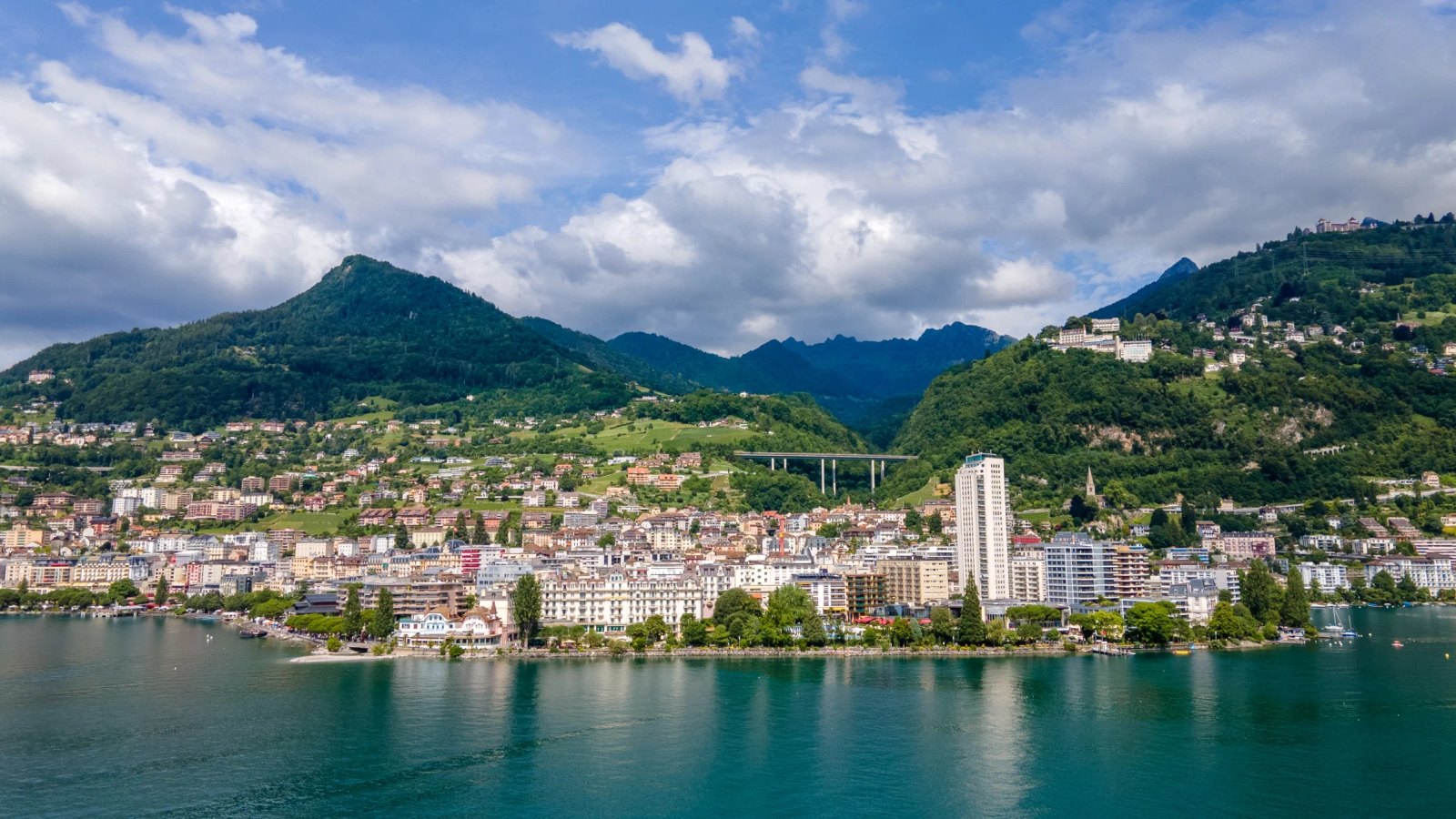
Montreux occupies the finest curve of Lake Geneva, where the Alps plunge into the water. The town spreads in terraces from the lakeside up to the hillside villages, from Territet to Clarens, from Chernex to Glion. Its climate is a gentleness: sheltered from the north winds, the Vaud Riviera lets palm trees grow on its quays and grapes ripen on its slopes. From the station, set in the heart of the town, everything is within reach: the lake below, the mountain above, and the long ribbon of flowered promenades linking the two.
From wine-growers’ villages to the pearl of the Riviera
Before the town, there were villages. Fishermen and wine-growers had lived here since the Middle Ages, gathered around their churches, from Les Planches to Clarens. The present commune is young: it was born in 1962 from the merger of Le Châtelard and Les Planches. Its fame, however, goes back to the Belle Époque, when the railway brought wealthy visitors from all over Europe. Within a few decades, the small town became a cosmopolitan resort, hotels sprang up along the water, and Montreux built a reputation for gentle living that has never left it.
The golden age of the palaces
From that era, Montreux has kept a crown of grand hotels. The Montreux Palace, a long white vessel of 1906, reigns over the quays; at Territet, the Grand Hôtel and the Eden Palace au Lac recall the splendour of old, when kings and tsarinas spent the winter by Lake Geneva. To lift these guests up to the view, funiculars among the oldest in Switzerland were built, including the one from Territet to Glion in 1883. Turreted façades, verandas, terraced gardens: Belle Époque architecture still shapes the face of the town.
“Smoke on the Water”, the birth of a myth
On 4 December 1971, the Casino caught fire during a Frank Zappa concert. From across the bay, Deep Purple, who had come to record in Montreux, watched the smoke spread over the lake. From that image was born “Smoke on the Water”, one of the most famous riffs in rock history, and a song that tells the story of the town itself. A few years later, Queen made Montreux their home port and bought the Casino studios. Ever since, smoke on the water has become the emblem of a town that tells its story in music.
The capital of festivals
Montreux lives to the rhythm of its festivals. In July, the Montreux Jazz Festival, founded by Claude Nobs in 1967, makes the town the world meeting-place of jazz and contemporary music. In autumn, the Septembre Musical brings the great classical orchestras, a tradition born in 1946. When winter comes, the quays light up for Montreux Noël, one of the largest Christmas markets in Switzerland. And the town keeps the memory of the Rose d’Or, the international television festival that, from the 1960s to 2003, drew the greatest stars here.
UNESCO creative city of music
In November 2023, Montreux joined the UNESCO Creative Cities Network for music. It thus enters a worldwide family of cities that make creativity a driving force of their life and exchanges, alongside great musical centres from all five continents. For a town of fewer than thirty thousand inhabitants, it is recognition of a rare journey: more than half a century of festivals, studios and encounters that have written, season after season, a part of the history of music.
A land of illustrious guests
The gentleness of Montreux has held on to many artists. At Clarens, Igor Stravinsky composed “The Rite of Spring” and Tchaikovsky his Symphony; at the Montreux Palace, the writer Vladimir Nabokov lived his last sixteen years. Lord Byron, for his part, had immortalised the Château de Chillon as early as 1816. In the 20th century, the town became a land of musicians: Freddie Mercury and Queen settled here, David Bowie made the Riviera his home, Quincy Jones returned every summer to his friend Claude Nobs. Many now rest on these heights they had chosen.
From the quays to the summits
The flowered promenade along the lake is the soul of Montreux: nearly ten kilometres of gardens, sculptures and terraces, from Vevey to Chillon. Along it you meet the statue of Freddie Mercury facing the lake, the covered market and the Stravinski Auditorium of the convention centre. Then the town rises up: the rack railway climbs towards Glion, Caux and the Rochers-de-Naye, at 2,042 metres. In an hour, you go from the palm trees at the water’s edge to the edelweiss of the summit, a whole country held in a single glance.
Linked to the world
Small in size, Montreux is large in its friendships. Since 1953, it has been twinned with Menton, on the French Riviera, and Wiesbaden, in Germany, two spa and music towns in its own image. To these twinnings are added friendship pacts forged over the decades with Chiba in Japan, Atlanta and Dallas in the United States, and Montréal in Canada. Through its festivals exported to several continents and through the UNESCO network of music cities, the town on Lake Geneva weaves, from Montreux to the world, a web of exchanges in which music always plays the leading role.
Related artists :Freddie MercuryDeep PurpleIgor StravinskiPiotr Ilitch TchaïkovskiDavid BowieQuincy JonesClaude Nobs