Classical music
Piotr Ilitch Tchaïkovski

Pyotr Ilyich Tchaikovsky (1840-1893) stayed three times in Clarens between 1877 and 1879, at the Villa Richelieu. He came there to escape: his marriage had just collapsed and his nerves were in a poor state. Yet it was there, facing Lake Geneva, that he wrote one of the most played pages of the repertoire. His Violin Concerto in D major, begun on 17 March 1878, was fully orchestrated by 11 April: less than a month. He also worked in Clarens on “Eugene Onegin” and on “The Maid of Orleans”.
Tchaikovsky in Clarens: a concerto in less than a month
Three stays at the Villa Richelieu
Tchaikovsky discovered Clarens in the autumn of 1877, at a moment of personal crisis. He settled at the Villa Richelieu, a lakeside guesthouse, and there finished orchestrating the first act of “Eugene Onegin”.
He came back twice: from 9 March to 7 April 1878, then from January to mid-February 1879. Each time he had a piano installed in the salon and worked. The third stay was almost entirely devoted to “The Maid of Orleans”.
In a letter to his patron Nadezhda von Meck, a wealthy widow he would never meet, yet with whom he exchanged nearly fourteen years of correspondence and to whom he had just dedicated his Fourth Symphony, he confided what the place meant to him: “Outside Russia, I know of no place where the soul can find peace as it does in Clarens. After the restless life of Florence, this quiet corner by the majestic lake, facing the gigantic mountains covered in eternal snow, stirs in me feelings that are somewhat melancholy. Yet I do not for one moment regret that we came here. In my room there is a very good piano.”
Autumn 1877: the Fourth Symphony, “Fate”
This first stay, in the autumn of 1877, was not merely an escape. At thirty-seven, already famous, three symphonies, a first piano concerto, “Swan Lake”, Tchaikovsky was going through an intimate crisis after a disastrous marriage. Clarens offered him what Byron, reading Rousseau, had already sung of in “Childe Harold”: a refuge “from the worldly shocks”.
It was there that he threw himself into his Fourth Symphony, the one of “Fate”. The first movement opens on a fanfare of horns, the implacable call of destiny, before the strings open out the space of the Russian plains; the Andante “in modo di canzona”, for its part, seems born of the Lake Geneva calm. In October 1877 he wrote to Nikolai Rubinstein that he could not finish “Eugene Onegin”, so “terribly drawn” was he “to the symphony which, I think, is the best I have written so far”.
He dedicated it to Nadezhda von Meck, “my best friend”, the benefactress who financed these stays and to whom, year after year, he would confide his states of mind (Tchaikovsky Research, Klin; Constantin Floros, “Peter I. Tschaikowsky”, 2019).
Spring 1878: the Violin Concerto
The second stay was the most fruitful. Tchaikovsky was accompanied by his brother Modest, then joined by the violinist Iosif Kotek, a former student from his theory classes in Moscow and, most likely, more than that.
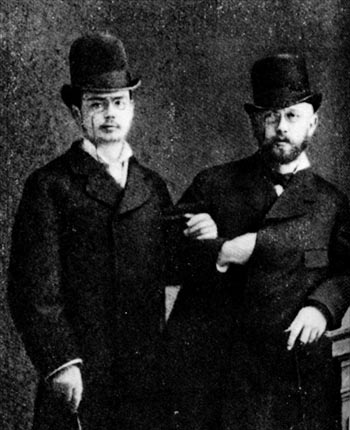
Kotek’s presence changed everything: the composer, who was not a violinist, suddenly had a performer to test every idea on. Together they read through Édouard Lalo’s newly published “Symphonie espagnole”, which gave him the spark. He began the Violin Concerto in D major on 17 March 1878. By 11 April the work was fully orchestrated.
Less than a month for a concerto now played the world over, and one first judged unplayable by its intended dedicatee. It was born in Clarens, in a lakeside guesthouse.
The Villa Richelieu and the Clarens of musicians
The Villa Richelieu has gone, and its site has changed face three times: it became the Hôtel Continental, was demolished, then replaced in 1982 by the Hyatt, today the Royal Plaza, west of the Parc Vernex.
Tchaikovsky shares Clarens with Igor Stravinsky, who would compose “The Rite of Spring” there thirty-five years later: two Russian revolutions in music written in the same village. The Violin Concerto, for its part, carries the mention of its Swiss birth in every biography of the composer. He had in fact known the region for a long time: his diary of 25 July 1873 shows him walking from Vevey to Montreux and visiting the Château de Chillon, the very castle that had inspired Byron’s “The Prisoner of Chillon”; from his admiration for the English poet would later come his “Manfred” Symphony (1885). He thus joined the Romantics already drawn to Lake Geneva, from Felix Mendelssohn to Richard Wagner, before a Richard Strauss would follow still. Swiss public radio RTS devoted two episodes of its programme “L’Oreille d’abord” to this stay (1; 2); the Vaud scholar Pierre Meylan had already devoted an article to it in the Feuilles musicales in 1954.
These places on the map
Tap a marker to open the place page.