Homes, hotels & restaurants
Hôtel des Trois Couronnes

- Type
- Historic hotel
- Address
- Rue d’Italie 49, 1800 Vevey
Set on the Rue d’Italie, facing the lake and the Savoy Alps, the Hôtel des Trois Couronnes opened its doors on 3 May 1842. The second palace hotel built on the Lake Geneva arc after the Hôtel des Bergues in Geneva, for nearly two centuries it saw a procession of emperors, tsarinas and crowned heads, but also of musicians. It was here that, in May 1913, on the eve of a concert at the Casino du Rivage, Camille Saint-Saëns and Ignacy Jan Paderewski rehearsed the former’s “Polonaise” for two pianos; the house still counts Pyotr Ilyich Tchaikovsky among the musical figures linked to its history. Writers and film-makers did the rest: Henry James set his novel “Daisy Miller” (1879) here, filmed on the spot a century later.
A palace on the Riviera, since 1842
1842: a palace born from a castle
The hotel rises on the walls of the château des Belles Truches, a fortified house that controlled the small adjoining harbour and levied customs duties. Its owner, Gabriel Monnet, from a long line of Vevey hoteliers, set out to capture passing tourists and entrusted the plans to the Vevey architect Philippe Franel (1796-1867), who also gave the château de l’Aile its neo-Gothic look.
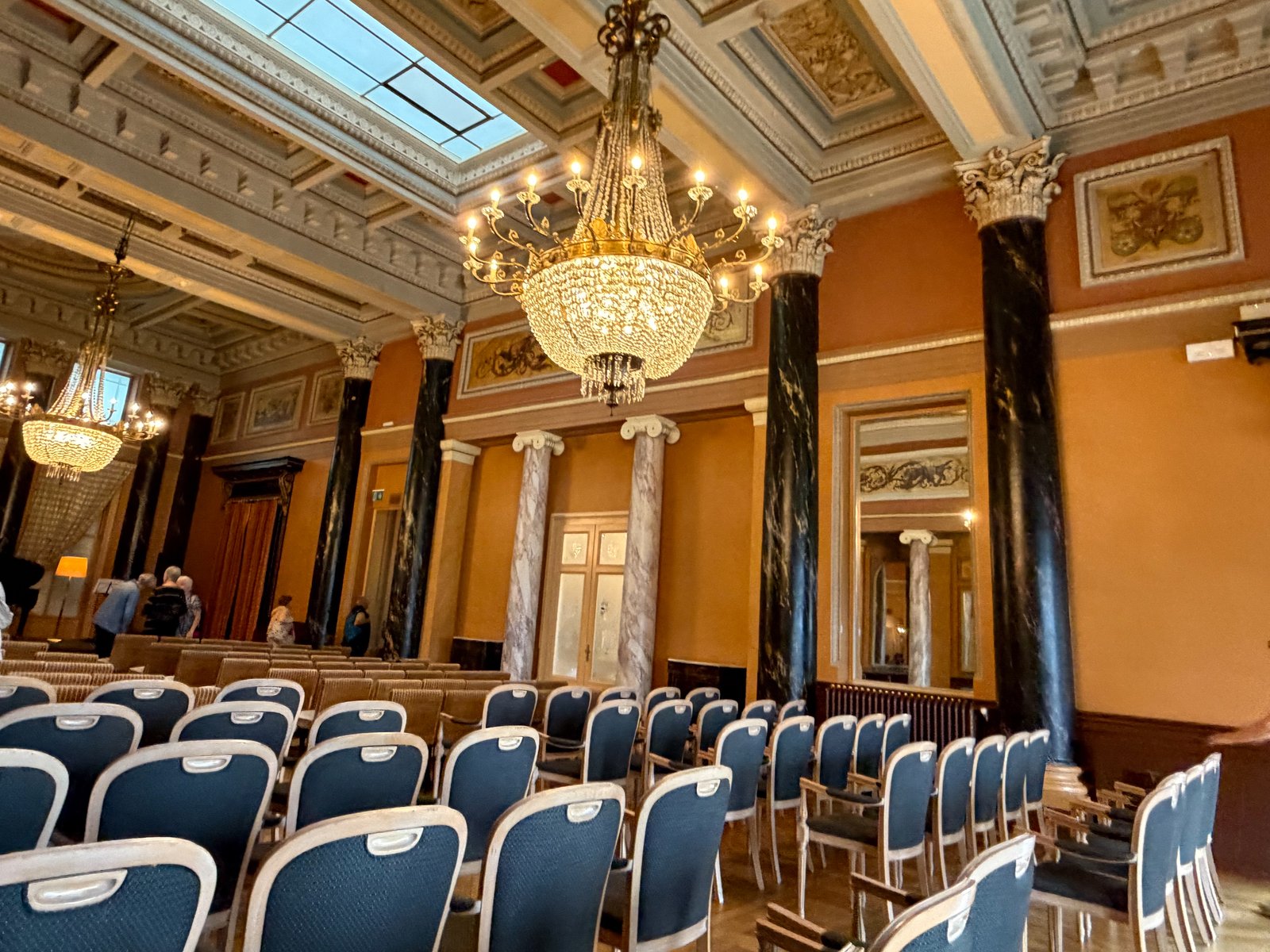
Franel devised a bright hall pierced with glass roofs, a vast light well, and rooms in a row that could be combined into suites. The Trois Couronnes soon earned its palace status, the second built on the Lake Geneva arc after the Hôtel des Bergues in Geneva (Musée historique de Vevey; Luigi Napi, art historian).
The procession of crowned heads
From its opening, the hotel welcomed the great of this world. “There one saw in succession the emperors of Germany and Russia, and other sovereigns, notably the former king Jérôme Bonaparte” recounts the hotelier Fédia Muller in his 1959 monograph. The Murray guidebook described a courtyard full of vehicles “from the ramshackle carriage of the German coachman to the trim coupé of the English lord and the imposing equipage of the Russian prince”. In 1859 the Empress Alexandra Feodorovna, widow of Tsar Nicholas I, rented the whole establishment for a winter.
The splendour continued: the Prince of Wales, the future Edward VII, stayed there; in 1873 the Shah of Persia Naser ed-Din dined there with King William III of the Netherlands, who had come incognito. Later, the Aga Khan III celebrated his marriage to Yvette Labrousse there. In the midst of war, the manager Marcel Herminjard had to be cunning: “We were in the middle of rationing and the Aga Khan wanted two meats at the meal, whereas the wedding day fell on a meatless day!”, he recounts in his “Souvenirs d’un hôtelier veveysan” (1976).
Saint-Saëns and Paderewski at two pianos
The hotel’s finest musical moment takes place in May 1913. For the Fêtes musicales de Vevey given in honour of Camille Saint-Saëns, the hotel hosts rehearsals and receptions. In a salon, before a concert at the neighbouring Casino du Rivage, Saint-Saëns and Ignacy Jan Paderewski rehearse the French master’s “Polonaise” for two pianos. It is said that a nervous Saint-Saëns told his junior: “Let us work, we have to be up to it!”
Of that musical friendship, one image remains: the photograph of Saint-Saëns, the Vaud conductor Gustave Doret and Paderewski, enlarged, still hangs in the hotel’s reception. The house also counts Camille Saint-Saëns and Pyotr Ilyich Tchaikovsky among the great musical figures linked to its history.
From “Daisy Miller” to today
The hotel also has its literature. At the end of the nineteenth century, the British writer Henry James set “Daisy Miller” (1879) here, the story of a young American woman whose manners displeased the Europeans. Nearly a century later, the director Peter Bogdanovich came to Vevey to shoot the film version, with Cybill Shepherd. “Every morning, the star of the film came to kiss me. A gesture that was enough to put me in a good mood for the whole day” recalls Marcel Herminjard. The photographers Jeanloup Sieff and Helmut Newton were also drawn to the place.
The house carried its cultural tradition into the twentieth century with guests such as the artist and writer Sir Peter Ustinov, while Charlie Chaplin, settled nearby at the Manoir de Ban, embodied the Riviera of the cinema. Passing through some twenty years ago, the actress Nathalie Baye wrote in the guest book: “I am very happy to be in your hotel. One feels out of time here, and it is good for dreaming.”
Related artists :Camille Saint-SaënsIgnacy Jan PaderewskiPiotr Ilitch TchaïkovskiCharlie Chaplin