Towns & landscapes

- Type
- Hillside village & mountain station
- Address
- Glion, Montreux
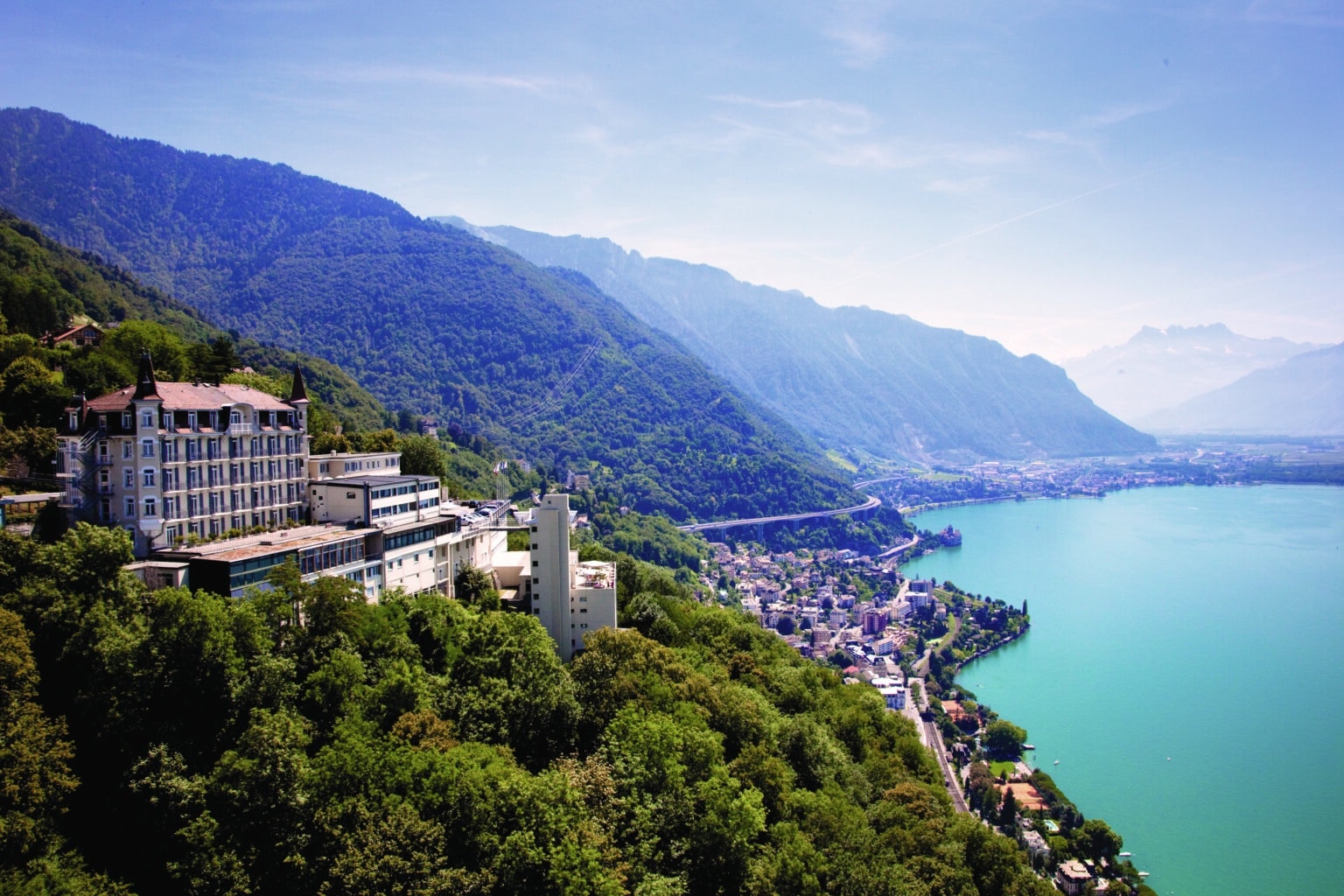
At some 700 metres, clinging above Montreux and Territet, Glion is one of the finest viewpoints on the Riviera. You can reach it three ways: by car, by the rack railway from Montreux, or by the funicular that climbs from Territet, one of the oldest in Switzerland. In the Belle Époque, its grand hotels drew an international clientele for the air and the view; today the village is home to the famous Glion Institute of Higher Education and the Clinique Valmont, where dancers, writers and artists have been treated. Glion is also a stop on the legendary line up to the Rochers-de-Naye, at 2,042 metres.
Glion, the balcony of Montreux
Three ways up to Glion
Perched at some 700 metres above the lake, Glion is easy to reach: by car on the winding road, by the rack railway that has climbed from Montreux since 1909 on the Rochers-de-Naye line, by the funicular rising from Territet, opened in 1883 and one of the oldest in Switzerland, or on foot along the paths and stairways that climb up from the shore. From the terrace of the Buffet de la Gare, the reward is immediate: the whole of Lake Geneva and the Alps open up at once.
A jazz sleeve shot at Glion station
Glion has its own record sleeve. In 1969, the American trumpeter Clark Terry, mentor to Miles Davis and Quincy Jones, performed at the Montreux Jazz Festival with a big band. For the album drawn from the concert, “Clark Terry at the Montreux Jazz Festival” (1970), the cover photo was taken at the top of the funicular, at Glion station, the lake below; on the back appears the Château de Chillon. The setting of Glion thus literally became a jazz cover.

The Montreux Jazz Train, jazz on rails
The line that runs through Glion long thrummed to jazz. From 1991 to 2019, the Montreux Jazz Train was part of the festivities: born of an idea by Niklaus Mani, of the MOB railway, and immediately embraced by Claude Nobs, such a train fanatic that he wanted them every day: it added carriages to the timetable where bands played live, going up, at the summit and coming down. Travellers climbed to the Rochers-de-Naye, at 2,042 metres, or towards Gstaad, to the beat of New Orleans jazz; one train even bore the name “Funky Claude’s Jazz Train”, in homage to the founder.
The formula kept reinventing itself to the very end: in 2019, a bluegrass and rockabilly train still climbed to the summit, the final vintage of an adventure spanning nearly thirty years. On the lake, musical boats such as the Brazil Boat and the Funky Claude’s Boat carried the same idea. What remains is the memory of one of Claude Nobs’s finest inventions: taking the music to the mountains.
A balcony dear to musicians
The Glion viewpoint has never ceased to draw artists. In March 2025, Brian May, guitarist of Queen, was still photographing a sunset over the lake there, right by the Hôtel Victoria. And long before him, Henri Nestlé, founder of the famous Vevey company, chose Glion to spend his summers: it is there that he died, in 1890.
A Belle Époque viewpoint
Glion owes its fortune to hospitality. It all began in 1854, when the Geneva banker Jacques-Marie-Jean Mirabaud had the first Hôtel Righi Vaudois built in the shape of a chalet: its success launched the village’s rise. A second Righi Vaudois rose beside it in 1866, then other grand hotels, which in the Belle Époque drew an international clientele seeking pure air and the view, crowned heads and writers among them.
From that era the village keeps its villas, its shaded avenues and that taste for the panorama that invites a pause at every bend.
From the hotel school to Maison Décotterd
That tradition of hospitality found a sequel. In 1962, professors Walter Hunziker and Frédéric Tissot set up, in the former Grand Hôtel Bellevue, the first private university-level hotel school in Switzerland, the Glion Institute of Higher Education: ever since, it has trained hospitality managers from around the world. And since 2021 the site has housed an exceptional table: after ten years at the Pont de Brent, chef Stéphane Décotterd opened Maison Décotterd there, honoured by the Michelin Guide, where fine dining is savoured facing Lake Geneva and the Alps. In Glion, the art of welcoming is both taught and tasted.
The Clinique Valmont
Glion is also home to an institution apart: the Clinique Valmont, opened in 1905, which treated kings, writers and artists for over a century, from Maurice Béjart and Roland Petit to Grace Jones, before devoting itself to rehabilitation.
The gateway to the Rochers-de-Naye
A mere stop for many, Glion is in fact the gateway to the mountain. It is here that the train from Montreux begins its long climb towards Caux and then the Rochers-de-Naye, at 2,042 metres. Between lake and summits, the village is the link in one of the finest railway journeys in Switzerland.
A rumour around Freddie Mercury
A late rumour links Freddie Mercury to Glion. In “Love, Freddie” (2025), Lesley-Ann Jones reports the account of a woman claiming to be his daughter, with whom the Queen singer is said to have spent time at the Hôtel Victoria, between 1990 and 1991, towards the end of his life. Nothing is established: the account is unverifiable, and the hotel has kept no record and confirmed nothing. Take it for what it is: a rumour.
Related artists :Clark TerryBrian MayFreddie MercuryHenri NestléClaude Nobs