Festivals & events
Septembre Musical

- Type
- Classical music festival
- Address
- Av. Claude-Nobs 5, 1820 Montreux
Founded in 1946, the Septembre Musical is the classical side of Montreux musical life, twenty years older than the Montreux Jazz Festival. It has brought the continent’s great symphonic and chamber orchestras to the Riviera, and ranks among the oldest festivals of its kind in Switzerland. Its programme today spreads across five emblematic venues, the Auditorium Stravinski at the 2M2C, the Château de Chillon, the Caux Palace, the Fairmont Le Montreux Palace and the Théâtre Le Reflet, combining, under the name Classic & Lab, major ensembles with more exploratory formats. It was this festival that, in September 1971, programmed Pink Floyd at the Pavillon: a boldness that remains famous for an institution devoted to the classical repertoire. The conductor Josef Krips, who lived in Territet, was one of its first major donors and conducted it seven times between 1952 and 1971.
The Septembre Musical, from 1946 to today
1946: a festival born of exile
The first edition was held on 6 September 1946, at the Casino-Kursaal in Montreux. Switzerland had only just emerged from its wartime isolation, and it was precisely the presence, on the Riviera, of celebrated musicians, refugees or already settled in a region famed for its mildness, that gave founder Manuel Roth the idea for the festival: he simply had to persuade these artists, already on the spot, to perform. Roth would direct the Septembre Musical until 1967.
From the earliest editions, the presence of world-renowned soloists such as Martha Argerich, Arthur Rubinstein, Yehudi Menuhin and Isaac Stern established the festival’s international reputation; today it is the second-oldest classical music festival in Switzerland, after Lucerne’s.
Josef Krips and Arthur Rubinstein, two festival regulars
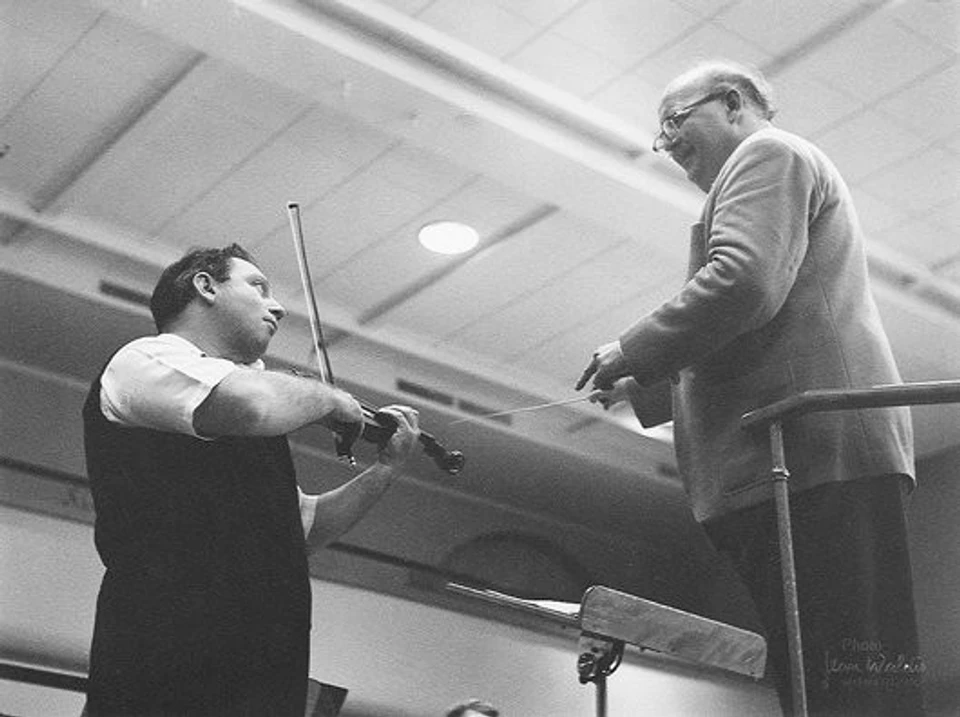
The conductor Josef Krips, won over by the Riviera during a 1952 engagement, settled in Territet that same year and became one of the festival’s very first major donors, conducting it seven times between 1952 and 1971.
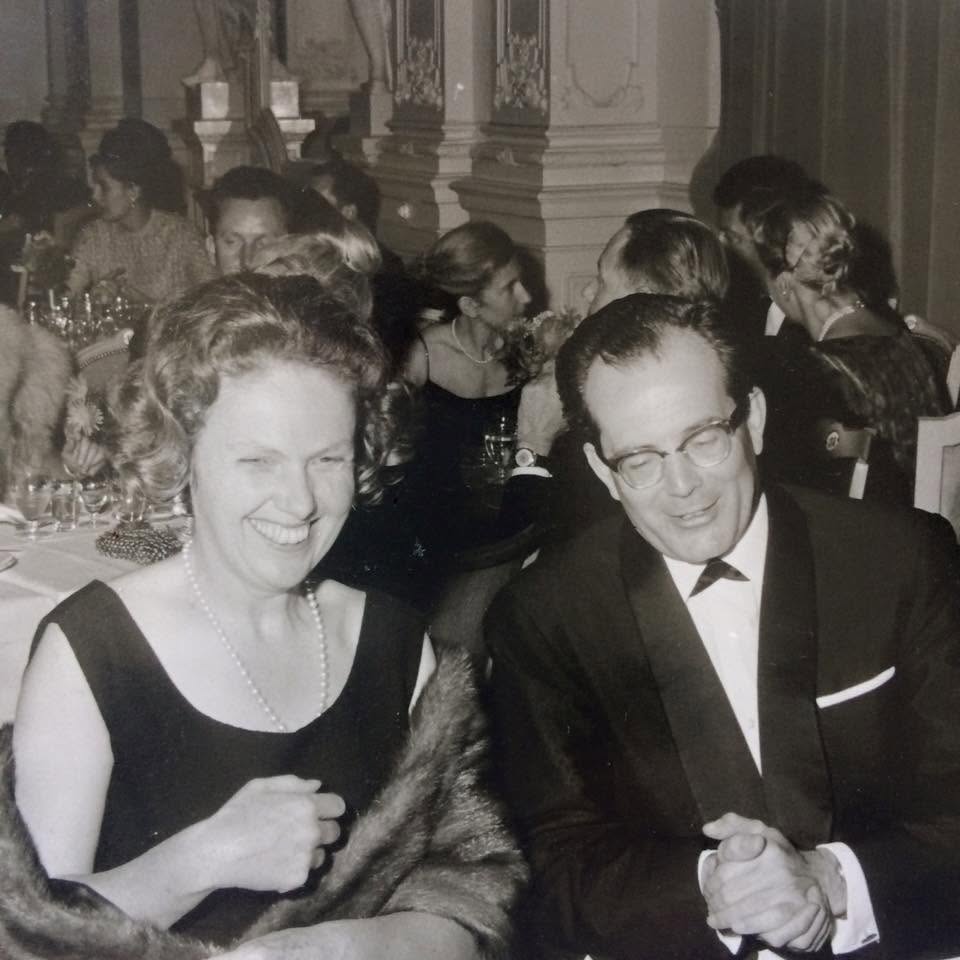
The pianist Arthur Rubinstein, who had discovered the region while staying at the Caux Palace as early as 1905, took part eight times between 1958 and 1965. In 1973, at eighty-six, he returned to Montreux to receive the Prix mondial du disque, a year after the violinist Joseph Szigeti, himself settled on the shores of Lake Geneva and a festival regular.
1956: Stravinsky conducts his own works
In 1956, Igor Stravinsky himself conducted some of his compositions as part of the festival. That link would remain permanently etched into the musical landscape of the Riviera: when, in 1993, the festival gained an eighteen-hundred-seat concert hall designed specially for it, the hall was named Auditorium Stravinski in memory of that visit.
The festival through the eyes of Swiss-French radio and television
Over the editions, the Septembre Musical brought together some of the greatest performers of the century: the pianists Artur Schnabel, Rudolf Serkin and Robert Casadesus, the violinists Nathan Milstein and Joseph Szigeti, the cellist Pierre Fournier. The conductor Wilhelm Furtwängler also led “Till Eulenspiegel” there before the eyes of its composer, Richard Strauss, seated in the front row. Very early on, the Radio romande broadcast the festival beyond Switzerland’s borders and kept the tapes at its sound archive in Lausanne.
For the festival’s twentieth anniversary, in August 1965, founder Manuel Roth looked back on how it came into being and on the radio’s role in carrying the concerts abroad.
In 1967, for the twenty-second edition, the violinist Isaac Stern rehearsed Felix Mendelssohn’s Violin Concerto with the Orchestre de la Suisse Romande under Jean Martinon. Of that fine moment only a short excerpt survives in RTS’s archives, broadcast in Carrefour-Soir Information on 4 September 1967.
For the festival’s twenty-fifth anniversary, the Vaud composer Julien-François Zbinden wrote “Lemanic 70”, an overture for choir and orchestra premiered on 23 September 1970; in September 1977 the Agenda programme followed him rehearsing the work from the podium.
1971: Pink Floyd at the Pavillon
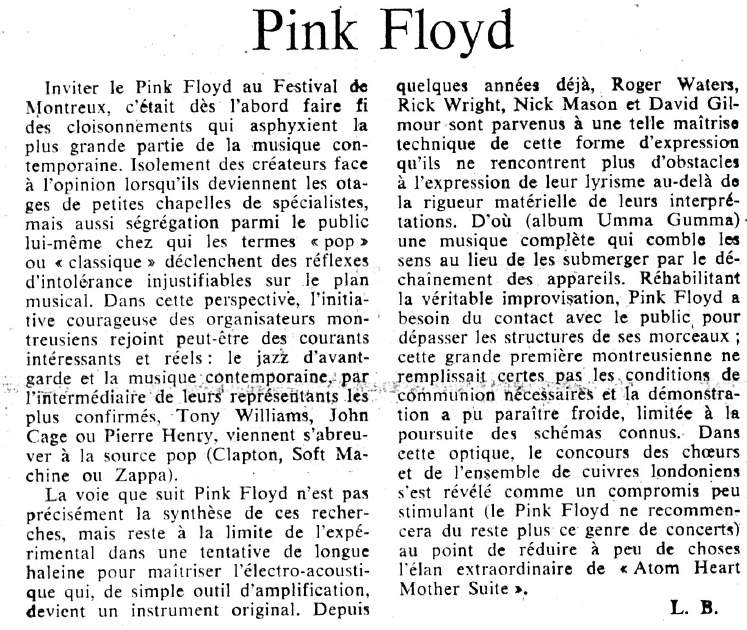
“Le Septembre musical, the most venerable, the most ‘dignified’ of Montreux’s events, is staging its own little revolution this year” wrote the journalist Renato Hofer in L’Illustré on 2 September 1971. By inviting Pink Floyd, “a sacred monster of pop music”, to play at the Pavillon, festival director René Klopfenstein was letting the wolf into the sheepfold. His reasoning came down to one sentence: “The differences in conception and approach between classical, contemporary, pop and jazz music are increasingly fading. In the end, only ‘music’ will exist. I’m for that.” He was well aware of the shock to come: “My subscribers will certainly be surprised.”
Some subscribers did indeed take the shock badly: one confided to the journalist that inviting these “junkies” into a hall graced by so many celebrated musicians amounted to a scandal, even a sacrilege, and that “they” would play without him. Klopfenstein himself was under no illusions about what the episode revealed: “Music breeds an incredible segregation of audiences and classes.” Even so, the concert’s two thousand seats, the most expensive of the whole festival, had sold out months in advance, and Klopfenstein had to organise a second concert, on 19 September, to meet demand. The two evenings, carried by the “Atom Heart Mother Suite”, were released much later under the title “Live in Montreux”.
The same edition: a first Japanese orchestra, Krips and sacred music in Vevey
The 1971 edition was not only about Pink Floyd. Montreux welcomed back the Warsaw National Philharmonic and, for the first time, hosted a Japanese orchestra, the Yomiuri Nippon Symphony Orchestra of Tokyo, whose performance of Brahms’s Violin Concerto, with the young prodigy Mayumi Fujikawa as soloist, made a strong impression. Two Swiss ensembles rounded out the programme: the Basel Symphony Orchestra, and the Orchestre de la Suisse Romande under its conductor Josef Krips.
To keep up a well-established tradition, the church of Saint-Martin in Vevey hosted the sacred music concerts, with organ recitals by Jean Guillou and Lionel Rogg and two world premieres, by André Zumbach and Heinz Marti. The walls of the Château de Chillon, meanwhile, echoed with music from the courts of Henry VIII and Louis XIV: barely a kilometre from the Pavillon and its two thousand free spirits, a whole other world went on, that same year too, gathering as it always had.
Nathan Milstein, nineteen appearances on the bill
The second-oldest classical music festival in Switzerland after that of Lucerne, the Septembre musical was, in its first decades, one of the largest in Europe. “The audience came from Paris, Milan, Munich…”, sums up Laurent Maire, the Lausanne lawyer who has chaired the Fondation du Septembre musical since 2013. Recitals and chamber music concerts were concentrated in Vevey, while the Casino-Kursaal hall and later the Pavillon, in Montreux, hosted the great orchestras. The Orchestre National de Paris and Cologne’s Gürzenich Orchestra were, with the regular help of first-rank conductors, almost its house orchestras.
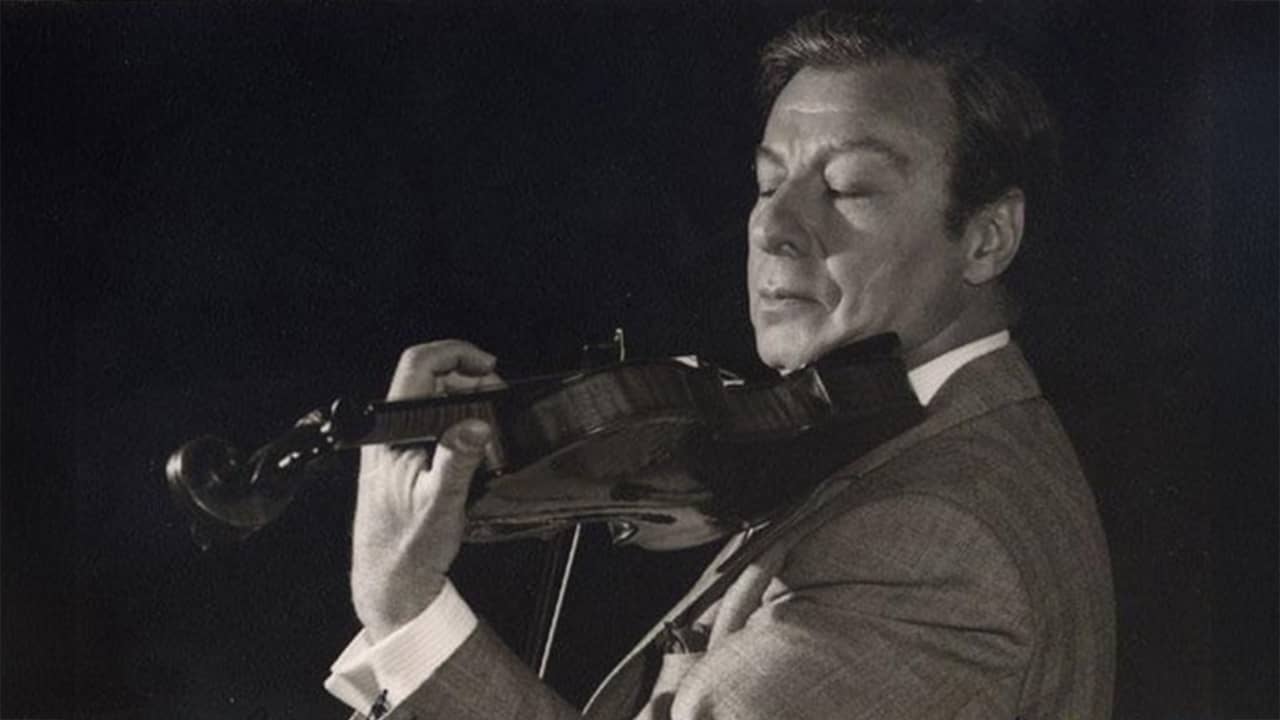
Some artists made themselves so at home that they settled there, such as the pianists Clara Haskil and Nikita Magaloff. The violinist Nathan Milstein, for his part, appeared no fewer than nineteen times. Josef Krips was one of its most faithful conductors (24 heures, Matthieu Chenal, 5 September 2026).
From René Klopfenstein to a slow renaissance
After René Klopfenstein (1968-1983), who had dared to programme Pink Floyd, Yves Petit de Voize ran the festival from 1984 to 1995 in the same spirit of continuity. It was under his tenure that the Auditorium Stravinski was inaugurated in 1993, designed to host orchestras in better conditions, though its eighteen hundred seats remain, even today, a challenge to fill for the regional population base. His successor, Christian Chorier (1996-2001), staked everything on voice and baroque music: magnificent programmes, but poorly suited to the venue and to local taste, with disastrous financial consequences.
It then took the tenacity of the festival's Friends, of the conductor Karl Anton Rickenbacher and of artistic directors Tobias Richter and then Mischa Damev to rebuild, little by little, a reputation and a regional footing, without being able to rival Lucerne or Verbier. “The pull of the greatest performers has faded and the Septembre musical's aura hasn't endured at the same level, but Mischa Damev has managed in recent years to restore the shine it deserves” sums up Jean-François Monnard, who was the festival's deputy director from 2007 to 2012 under Tobias Richter and traced its history in a book published for its 70th anniversary, in 2016 (In Folio). As a teenager in the 1960s, he had attended every rehearsal thanks to a favour from Manuel Roth: “I watched Josef Krips at work, fantastic in Beethoven's Ninth, but also Igor Markevitch or Wolfgang Sawallisch with the Czech Philharmonic. Such moments leave their mark. And it's thanks to them that I wanted to become a conductor” (24 heures, Matthieu Chenal, 5 September 2026).
The Auditorium Stravinski and the renewal
Today, the festival draws some eleven thousand spectators each year across its five emblematic venues. Since 2019, under the direction of Mischa Damev, each edition has spotlighted the culture of a different country, blending classical music, folk traditions, gastronomy and visual arts.
In 2024 and 2025, while the Auditorium Stravinski underwent renovation work, the festival launched “Classic Lab”, a creative laboratory bringing together first-rank artists: both editions sold out.
Audiences followed that shift: close to a third of recent editions’ spectators were between 18 and 30, and some two thousand pupils aged 8 to 15 are welcomed each year through schools. Tickets start at 39 francs, at 10 francs for young people. In November 2023, Montreux joined the UNESCO Creative Cities network in the music category (Revue Musicale Suisse, August 2026).
2026: the 80th edition, 8 to 18 September
The 80th edition, from 8 to 18 September 2026, marks the festival’s return to the Auditorium Stravinski after two years of works at the 2m2c. Ten concerts are spread across the five venues: Gautier Capuçon and the Capucelli ensemble at the Théâtre Le Reflet in Vevey; Marina Viotti and her “Melankhôlia” project, which sets John Dowland against Metallica, at the Caux Palace; Avi Avital and Ksenija Sidorova at the Château de Chillon; Kirill Gerstein and Brad Mehldau at the Montreux Palace. Daniil Trifonov and Ara Malikian complete the bill, the latter with a Montreux programme pairing Stravinsky and Quincy Jones.
Two evenings sum up the festival’s spirit. On 14 September, the guest country, Azerbaijan, brings together two hundred artists around music, dance and food. On the 16th, at the Auditorium Stravinski, the conductor Susanna Mälkki leads the orchestra Les Siècles, with the violinist Alexandra Conunova, in three works composed in Montreux: Tchaikovsky’s Violin Concerto, Stravinsky’s “The Rite of Spring” and Deep Purple’s “Smoke on the Water”, a very Montreux way of recalling that the Casino fire and “Smoke on the Water” belong to the same landscape as the great orchestras (24 heures, Matthieu Chenal, 5 September 2026; Revue Musicale Suisse, August 2026).
Related artists :Josef KripsCarl SchurichtPink FloydArthur RubinsteinJoseph SzigetiIgor StravinskiClara HaskilNikita MagaloffWilhelm FurtwänglerRichard Strauss