Classical music
Josef Krips

Josef Krips (1902-1974) was one of the great conductors of the twentieth century, renowned for a Mozart of limpid self-evidence. Born in Vienna and a pupil of Felix Weingartner, he conducted seventy-three different operas in seven years at Karlsruhe before his career was broken by Nazism: driven out of Germany in 1933 because of his father’s Jewish ancestry, barred from all activity after the Anschluss, he survived by working clandestinely in a factory. In 1945 it was he who was asked to revive the musical life of Vienna. His relationship with Montreux was a lasting one: he lived in Territet, was one of the first major donors of the Septembre Musical and conducted it seven times, from 1952 to 1971.
Josef Krips: from hiding in Vienna to the quays of Territet
A career broken by Nazism
Born in Vienna in 1902, Josef Krips began as a violinist at the Volksoper before becoming chorus master, then conductor. A pupil of Felix Weingartner, he was appointed music director at Karlsruhe at twenty-nine and conducted there, in seven years, seventy-three different operas. Bayreuth and Salzburg called on him.
In 1933 the Nazis drove him out of Germany: his father was of Jewish ancestry. He fell back on the Vienna State Opera, until the Anschluss of 1938. He tried Belgrade, but the war reached Yugoslavia in 1940 and he could return to Austria only by becoming a factory worker, clandestinely.
In 1945, in a city in ruins, it was he whom Vienna asked to take up the baton again and revive the musical life of the city.
Seven times at the head of the Septembre Musical
Krips was engaged by the Montreux music festival in 1952 to conduct the Gürzenich Orchestra of Cologne. The region struck him at once: “The Vaud Riviera, one of the most beautiful regions in the world, enchanted me to such a degree that I would have liked to live there one day.”
That came about the same year: he settled at Riant-Château, in Territet, on the Montreux quays, a building where the conductor Paul Kletzki also lived. “What a marvellous view we have! When I open the window in the morning, I can admire the Dents-du-Midi” he wrote. His attachment to the Riviera went beyond mere residence: he was one of the first major donors of the Septembre Musical.
He conducted the festival seven times, in 1952, 1954, 1958, 1960, 1964, 1965 and 1971, which makes him one of the most constant conducting figures in its history. His wife Harrietta still lived in Territet at the end of the 1990s.
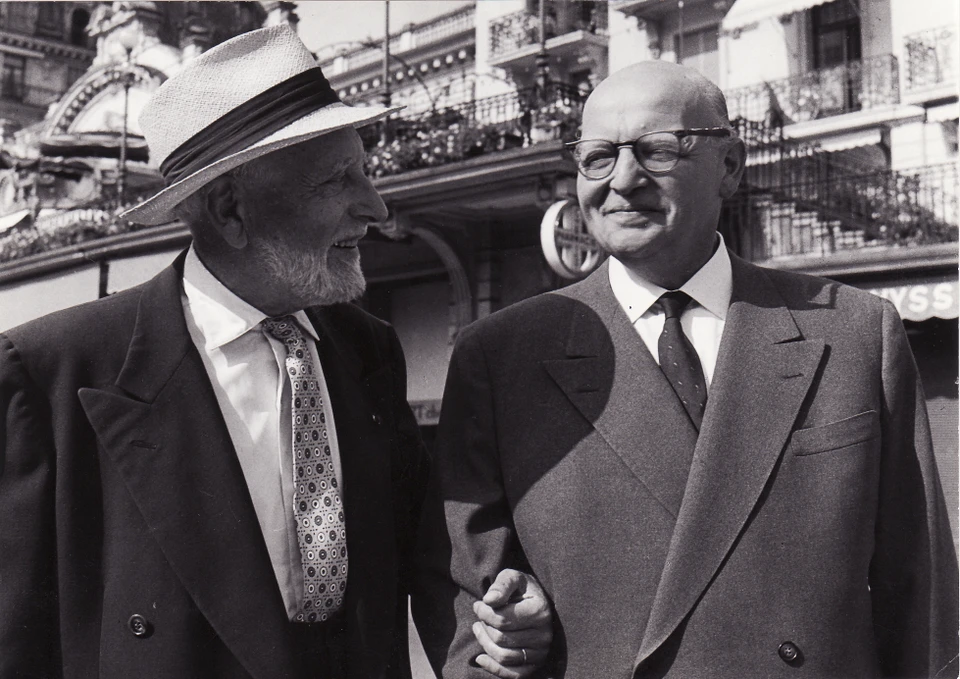
The music critic Numa F. Tétaz summed up his art thus: with him, the music seems to flow from the source, and that self-evidence rests on a rare balance between aesthetic perfection and a refusal of academicism.
Ansermet, Lake Geneva and a personal life marked by grief
It was Ernest Ansermet, whom he held in high esteem, who introduced Josef Krips to Lake Geneva, engaging him in 1951 as a jury member for the Geneva International Music Competition. Krips conducted in Vevey from 1952, then chose Montreux, in 1958, as the home base of his musical activity. A witty and talkative character, he liked to drive his own Mercedes to his engagements, even when it meant crossing Europe.
His personal life was marked by grief: in 1930, his young wife was killed in a car accident; he would not remarry until 1947. In 1969, his second wife died of cancer; that same year, he married the Austrian baroness and musician Harrietta Prochazka, a long-time friend of the region, who after his death gathered press cuttings, programmes and recordings toward a biography of the conductor.
Josef Krips died in Geneva in 1974, leaving music lovers a rich discographic legacy, notably the twenty Mozart symphonies he had just recorded at the head of the Concertgebouw Orchestra of Amsterdam.