Towns & landscapes
Lavaux

- Type
- Terraced vineyards, UNESCO
- Address
- Lavaux, rives du Léman, entre Lausanne et Montreux
Between Lausanne and Montreux, the slopes of Lavaux descend to Lake Geneva in a succession of terraces held up by stone walls, shaped by winegrowers since the Middle Ages. Inscribed as a UNESCO World Heritage site in 2007, this landscape of wine villages, Saint-Saphorin, Rivaz, Épesses, Cully, Lutry, is also a land of music. In spring, the Cully Jazz Festival fills the cellars and the streets; Lavaux Classic brings chamber music to the churches and the estates; the Festival Offenbach is held at Saint-Saphorin, while winegrowers such as Vitis Musicalis and the Domaine Wannaz host concerts among the vines. The region is explored on foot, from village to village, a glass in hand and a tune in mind.
Lavaux, the singing vineyards by Lake Geneva
A landscape listed by UNESCO
From Lutry, at the gates of Lausanne, to Villeneuve and the Château de Chillon, the Lavaux terraces cover around 830 hectares of vines over some thirty kilometres, held up by hundreds of kilometres of stone walls. It is one of the largest terraced vineyards in Europe, and one of the finest balconies over Lake Geneva and the Alps. Since 2007, this entirely man-made landscape has been a UNESCO World Heritage site.
The three suns of Lavaux
The winegrowers of Lavaux like to say that their vines receive three suns: the one that shines in the sky, the one reflected off Lake Geneva, and the one the stone walls store up by day to give back at night. It is this triple sunlight, together with the lake that softens the frosts, that gives the region’s Chasselas and reds their ripeness and finesse. The landscape is not just a backdrop: it makes the wine.
A thousand years of terraces
Lavaux was made by human hands. From the second half of the 12th century, the Cistercian monks of Montheron, Haut-Crêt, Hauterive and Humilimont cleared the steep slopes of the Dézaley and shaped them into terraces to plant vines. Their names can still be read on the labels: the Clos des Moines and the Clos des Abbayes, in the Dézaley, recall this monastic origin. Eight centuries on, these low walls and stone stairways still stand, maintained from one generation to the next.
‘Sauver Lavaux’
In the 20th century, the urbanisation of the Riviera threatened to swallow the vines. In 1972, the association ‘Sauver Lavaux’, led by the environmentalist Franz Weber, took the fight to the people. Vaud voters passed two constitutional protection initiatives, in 1977 and 2005, and a legislative one in 2014: each time, they chose to keep Lavaux green. It was this popular will, as much as the beauty of the site, that convinced UNESCO in 2007.
Music between the vines
Lavaux feeds more than the eye and the palate: through the year, music finds its place here. Each spring, the Cully Jazz Festival turns the little harbour of Cully into an open-air stage, from the main stages to the cellars of the ‘Off’. Lavaux Classic brings chamber music to the churches and among the vines, while at Saint-Saphorin the Festival Offenbach blends operetta and terroir. And at the winegrowers’, Vitis Musicalis, the Domaine Wannaz and Humus & Wine have turned their cellars into concert halls.
Jean Villard-Gilles, the poet of Saint-Saphorin
Born in Montreux in 1895, the songwriter and poet Jean Villard, known as Gilles, chose Lavaux to live and write. He settled in Saint-Saphorin, won over by the view of the lake, the Alps and the vines, setting down his piano and his writing table. He wrote “Les Trois Cloches”, which Édith Piaf and Les Compagnons de la chanson would carry around the world, and “La Venoge”, which became the tender anthem of the Vaud country. Above the village, “La Vigne à Gilles” keeps his memory alive with a harvest celebrated each autumn.
Pierre Keller, the son of Grandvaux
Lavaux had its flamboyant ambassador: Pierre Keller (1945-2019), who lived in Grandvaux, in the heart of the vineyard. Director of ECAL, the Lausanne art school he raised among the best in Europe, a trumpeter and a member of the Montreux Jazz Festival’s board of trustees, he also chaired the Vaud Wines office for eight years, championing Chasselas with the same panache as contemporary art. Provocative, generous, with a legendary address book, he connected vine, music and creation.
Stephan Eicher and the raft of the useless
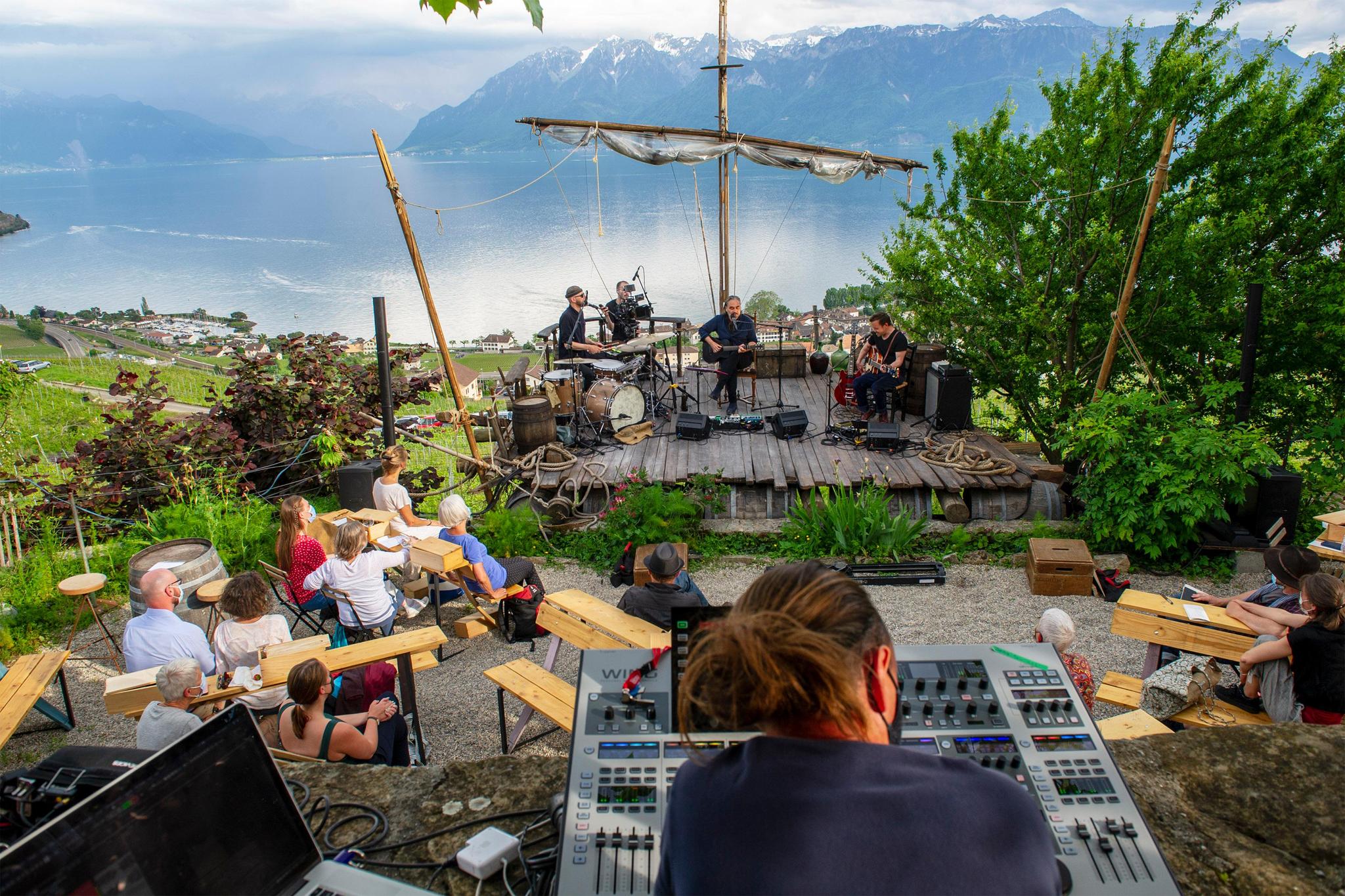
The singer Stephan Eicher also set down his bags among the vines. It was at the Domaine Wannaz, in Chenaux, that he developed ‘Le radeau des inutiles’, a wooden travelling stage designed to reconnect with audiences up close, far from the big halls. Between the vines, facing the lake, the music turns intimate there: a very Lavaux idea, where glass and song are shared.
Prince sings Lavaux
In 2010, Prince gave the vineyard the most unexpected of tributes: a song titled ‘Lavaux’, on his album 20Ten. The story begins in Montreux. There to play the festival, the artist did not want to go straight to his hotel: the head of transport, Simon Tomei, drove him through the slopes. Prince took notes, asked how to spell ‘Lavaux’, and was amused by the Nestlé headquarters in Vevey and its chocolates. From that drive came the song: the Vaud vineyard sung by a legend from Minneapolis.
Through the vines, on foot or by little train
Lavaux is explored on the vineyard paths that link the villages, from Saint-Saphorin to Cully by way of the Dézaley, a glass and a snack in the bag. To spare your legs, two little tourist trains wind between the vines: the Lavaux Express, from Lutry and Cully, and the Lavaux Panoramic, from Chexbres. From Montreux, a few minutes by train are enough to go from the festival quays to the vineyard terraces.
Related artists :PrinceStephan EicherPierre KellerJean Villard-Gilles