Rock & metal
Phil Collins

First the drummer, then the singer of Genesis, Phil Collins (born in London in 1951) is one of the best-selling voices of 1980s pop, from “In the Air Tonight” to “Against All Odds”. But at Montreux it was, above all, the drummer who was celebrated. With Genesis he played there as early as 1987 at the Casino, as part of the Rose d’Or. Then he returned to the Montreux Jazz Festival four times, in 1996, 1998, 2004 and 2010; in 1998 he even drew the festival’s official poster, born of one of his famous drummer doodles. Long settled on the Vaud shore of Lake Geneva, he came back in 2022 to the Château de l’Aile, in Vevey, to film the story of his life behind the kit.
Phil Collins and Montreux: the drummer behind the poster
Rose d’Or, 1986-1987: Montreux before the jazz
Phil Collins’s first meeting with Montreux came through television. In May 1986, Genesis came to promote “Invisible Touch” at the Rose d’Or, the town’s great international television festival: the band filmed three tracks in playback for the small screen, without playing to an audience. It was the same edition at which Queen hosted the press on a boat on Lake Geneva.
The following year, on 16 May 1987, Genesis returned for a real concert, this time at the Casino de Montreux, in the middle of the “Invisible Touch” tour. For Phil Collins it was the first great Montreux night: still the singer of a rock band, he did not yet know that he would soon be back as a jazz drummer.
1996: a drummer’s dream with the Big Band
On 17 July 1996, for the 30th Montreux Jazz Festival, Phil Collins fulfilled a long-held dream: to play jazz behind a drum kit, leading a large band of some twenty musicians. That night the baton was held by none other than Quincy Jones, and the guests were Tony Bennett and David Sanborn.
Demand for tickets was such that an extra concert had to be added in the late afternoon. Filmed by the festival, the concert would later be released on video as “Live at Montreux 1996”.
1998: the Phil Collins year, born of a doodle
Every year, Claude Nobs entrusted the festival poster to a different artist, after Andy Warhol, Keith Haring and David Bowie. For 1998 his choice fell on Phil Collins, but the idea came from further back: the festival’s founder had fallen for one of the musician’s “drummer doodles”, the small round figure he drew for autographs, sold two years earlier at a charity gala.
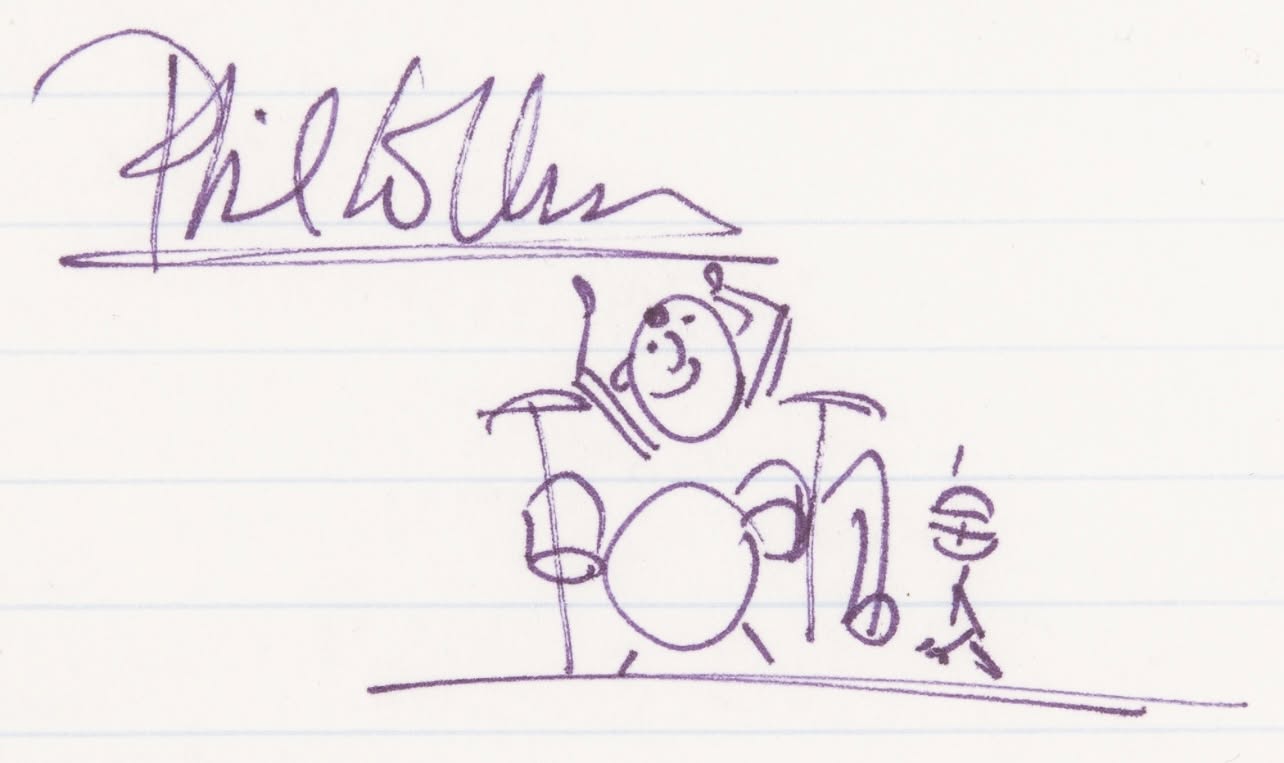
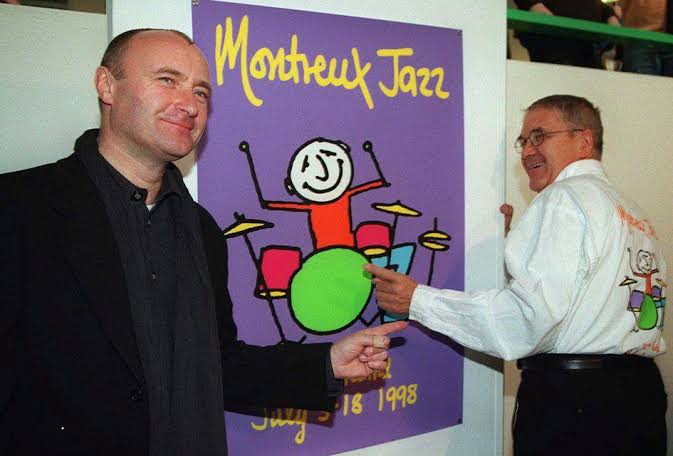
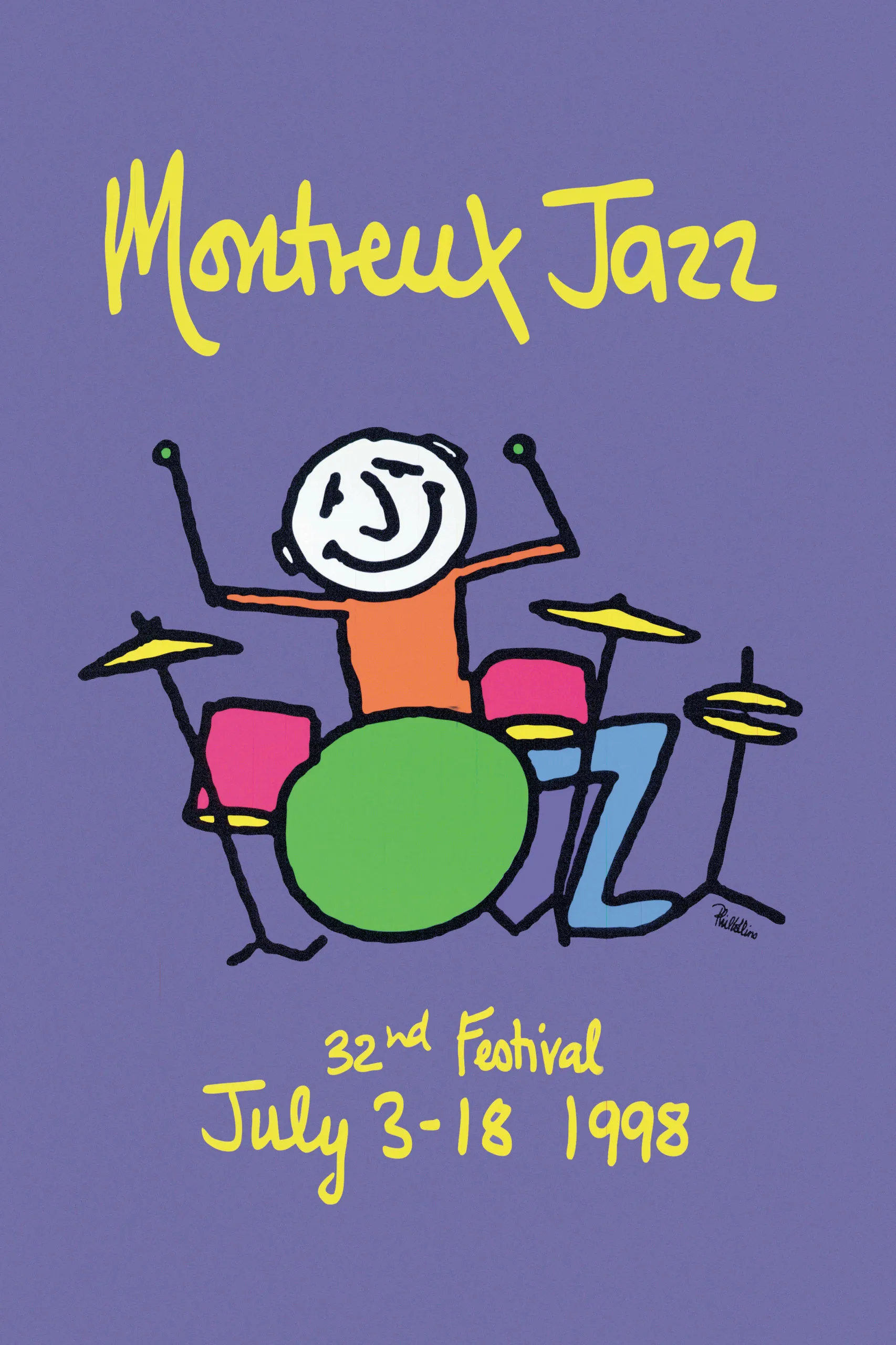
Collins reworked the motif for the 32nd festival: a drummer in full ecstasy behind his cymbals. He claimed, not without mischief, that this follically challenged figure was not a self-portrait. The poster was screen-printed by Albin Uldry, in Bern, in 700 signed and numbered copies. That same year Collins was back on the stage of the Auditorium Stravinski with his Big Band; the 1998 festival is also remembered as the one in which Montreux opened its doors to electronic music. A recording of “Pick Up the Pieces” would appear on the album “A Hot Night in Paris” (1999).
2004: the first of the farewells
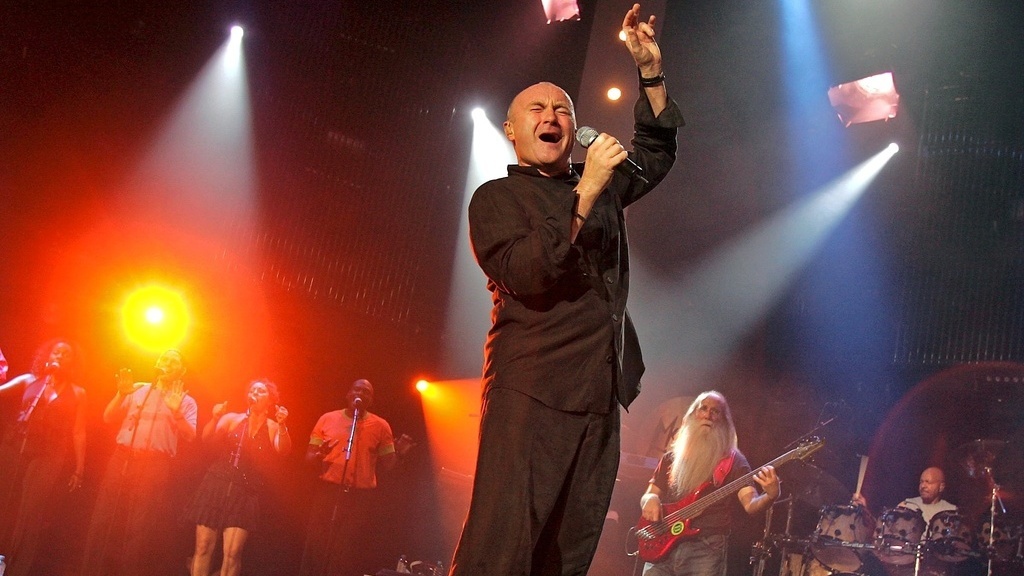
On 7 July 2004, Phil Collins chose the Auditorium Stravinski to give the very last concert of his “First Final Farewell Tour”, a nod to his old friend Claude Nobs. That night he was no longer the jazz drummer of 1996, but the pop star running through his hits: twenty-five songs, a drum trio to open with Chester Thompson and percussionist Luis Conte, and his faithful bassist Leland Sklar at his side.
The concert, one of the most complete of his career, was released on DVD and Blu-ray as “Phil Collins: Live at Montreux 2004”, together with the 1996 Big Band concert.
The concert also had an intimate resonance: it was from the Montreux stage, in July 2004, that Phil Collins told the audience of the coming birth of his son Matthew, born in Geneva a few months later.
2010: a last visit, on the soul side
Phil Collins returned one last time to the shore of Lake Geneva on 1 July 2010, for the 44th edition of the festival. This time, neither pop nor big band: he presented “Going Back”, his tribute to 1960s soul and Motown, surrounded by backing singers and a horn section.
It would be his last appearance on the Montreux Jazz Festival stage. Between the Genesis concert of 1987 and this 2010 soul revue, Montreux accompanied, over nearly a quarter of a century, the musician’s two lives: pop and the drums.
Château de l’Aile, 2022: the story of a drumming life
In October 2022, a few months after announcing his retirement at the end of the final Genesis tour, Phil Collins returned to the Vaud Riviera. From 18 to 21 October he settled at the Château de l’Aile, the neo-Gothic building overlooking Vevey’s Grande Place, for a long series of filmed interviews with his son Nic, himself a drummer.
Those days gave rise to the documentary “Phil Collins: Drummer First” (2024), produced by the teaching platform Drumeo: for the first time, he tells his career from the sole point of view of the drums, from his beginnings in Genesis to handing over to Nic on stage. The Lake Geneva setting of this testament is no accident: it is in the canton of Vaud that the musician has made his home for nearly thirty years.
A neighbour on the Vaud shore
Phil Collins’s bond with the Lake Geneva region is not limited to the stage. It was in Lausanne, at the Malley ice rink, that he met the Vaud-born Orianne Cevey on 26 April 1994, while touring for his album “Both Sides”. He soon settled in the canton of Vaud, at Begnins, on the heights of La Côte, then, after their divorce, at Féchy, where he keeps recording equipment. The couple had married in July 1999 at the Beau-Rivage Palace in Lausanne, with Elton John among the guests.
In February 2000, Phil Collins and Orianne founded the Little Dreams Foundation, on La Côte, which supports nearly two hundred young talents in music, the arts and sport. It was for the foundation that he resurfaced in 2016, at the Salle Métropole in Lausanne, at a gala where he returned to the stage for the first time since 2010. This is the western shore of Lake Geneva, on the Nyon side, a good hour’s drive from Montreux: Collins is not a child of the Riviera, but a familiar of the same lake.
Here one measures what draws the artist to Montreux: less a local biography than a twofold loyalty, to the lake where he has lived and to a festival that offered him, on several occasions, the chance to be above all a drummer.
These places on the map
Tap a marker to open the place page.